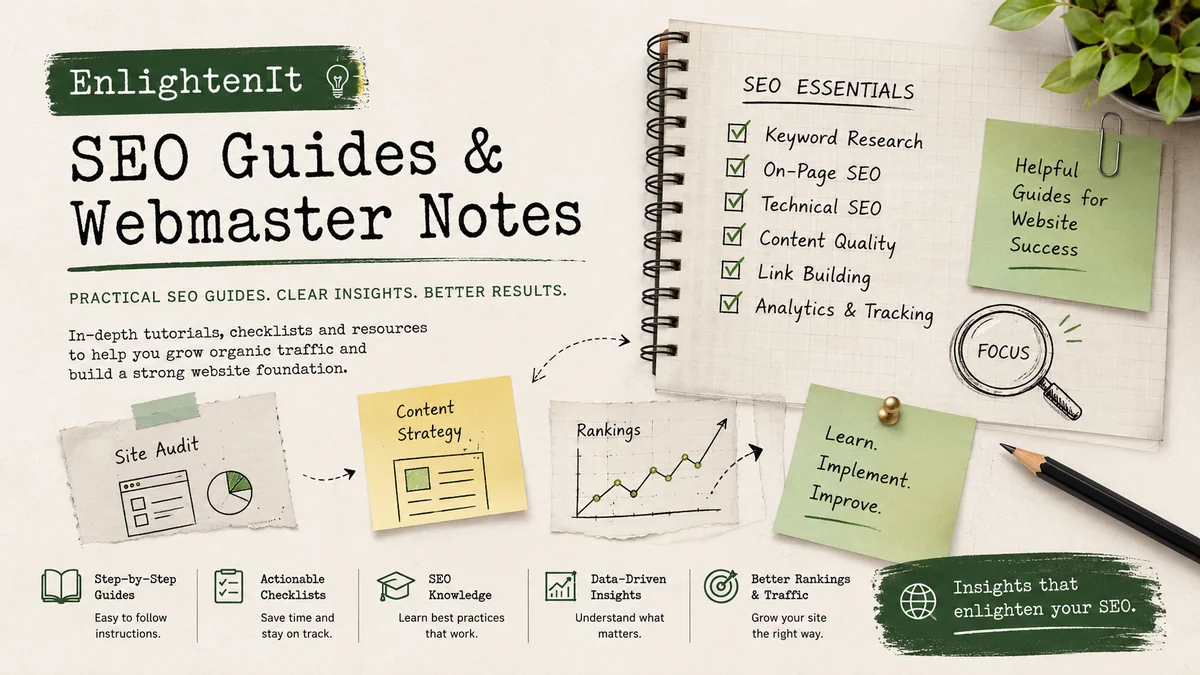
An on-page SEO score can be a useful checklist, particularly when it catches a missing title, weak heading or overlooked image description. The difficulty begins when the score becomes the objective. Different SEO tools grade pages according to their own rules, and a perfect indicator inside a plugin does not guarantee that a page is useful, competitive or capable of ranking. Improving the score should support better pages rather than dictate how they are written.
Understand what is producing the score
Open the tool's recommendations and separate genuine problems from stylistic preferences. Common checks cover titles, descriptions, headings, keyword use, links, content length and technical elements. Some are straightforward errors; others are heuristic suggestions.
Knowing the difference prevents unnecessary editing. A missing title deserves attention. A recommendation to repeat an exact keyword again may not, particularly if the topic is already clear and another repetition would make the sentence awkward.
Fix fundamental page elements first
Confirm that the page has a descriptive HTML title and a clear primary heading. Review the URL, indexability and canonical setup where relevant. Make sure important content is accessible rather than hidden behind a technical problem.
These basics matter independently of a plugin score. If a tool identifies them, fixing them improves the underlying page as well as the audit result. Technical correctness should take priority over cosmetic score improvements.
Check whether the chosen keyword matches the page
Many scoring systems evaluate a page against a focus keyword entered by the editor. If that phrase represents the wrong search intent, optimisation recommendations can push the content further in the wrong direction.
Revisit the page purpose and choose a phrase that accurately represents it. Then consider related terminology and questions that belong to the same intent. A strong page can be relevant to many searches without repeating one exact formulation throughout.
Improve the content rather than its keyword count
When a tool says a keyword is underused, first ask whether the page actually lacks subject coverage. Perhaps an important concept, process or decision factor is missing. Adding that information may naturally introduce relevant terminology.
If the content already answers the subject clearly, forcing more repetitions can make it worse. Write for comprehension and use the score as a prompt for review, not as a mechanical instruction.
Build a useful heading structure
Headings should allow somebody to scan the page and understand its major sections. Use one clear main heading in the page structure and descriptive subheadings for meaningful divisions in the content.
Do not add headings solely to place keywords in them. Likewise, do not select heading levels based only on visual appearance. A logical document structure helps readers and makes the page easier to maintain.
Review links in context
SEO tools often check whether a page contains internal or external links. The number alone is not the useful measure. An internal link should help the visitor reach a relevant page, while an external reference should support the content when an outside source is genuinely useful.
Remove links that exist only to satisfy a recommendation. Add links where they clarify a relationship, provide supporting information or create a sensible next step through the site.
Improve readability without writing to a formula
Readability checks can identify very long sentences, dense paragraphs and unnecessarily complicated language. These are useful editorial prompts, but specialist subjects sometimes require terminology or sentence structures that a generic scoring system dislikes.
Edit for your actual audience. Break up avoidable complexity, explain unfamiliar terms and make key points easy to locate. Do not simplify technical meaning merely to move an automated indicator from one colour to another.
Judge the page beyond the score
After making changes, read the page without looking at the optimisation panel. Does it answer the intended question? Is the information trustworthy and complete enough? Can a visitor understand what to do next? Does it add something worthwhile compared with other pages on your own site?
An on-page SEO score is most useful as quality-control assistance. Fix real omissions, investigate sensible warnings and ignore recommendations that would make the content less natural or less accurate. The strongest optimisation process uses tools to support editorial judgement rather than replacing it.